
Wake County Previous Residents by Era
A backward address trail uses different Wake County sources for different periods. Recorded instruments can identify parties and legal descriptions. Directories can associate a printed name with a date and address. Maps can test the building and street context. None of those sources alone proves continuous occupancy, so use the table as a route map rather than a single master list of past residents.
| Source | Years it covers | Where held | What it shows |
|---|---|---|---|
| CRPI old application | July 1785–April 17, 2025 | Wake County Register of Deeds | Recorded land-index and image route during the transition |
| New Land Records application | Current recording route after the transition | Wake County Register of Deeds | Recorded-document access for the current route |
| Raleigh directory catalog | 1880–2026, with catalog gaps | Olivia Raney Local History | Dated name and address listings |
| Raleigh Suburban Directory | 1969–1977; 2021 | Olivia Raney Local History | Separate edition lead outside the downtown core |
| DigitalNC Raleigh scans | 1925 and 1933 direct scan leads | DigitalNC | Image-based directory checks |
| Raleigh Sanborn maps | 1884–1950 | Library of Congress | Building, materials, and street context |
For a Wake County address with a recent deed, start with the current parcel and work backward through recorded instruments. For an older address question about who lived here before, start with the closest dated directory or map, then use the deed chain to test the parcel identity. The Suburban catalog is not a substitute for the Raleigh run, but it can close a useful geographic gap.
The Raleigh Suburban Directory catalog record confirms the separate local-history route.
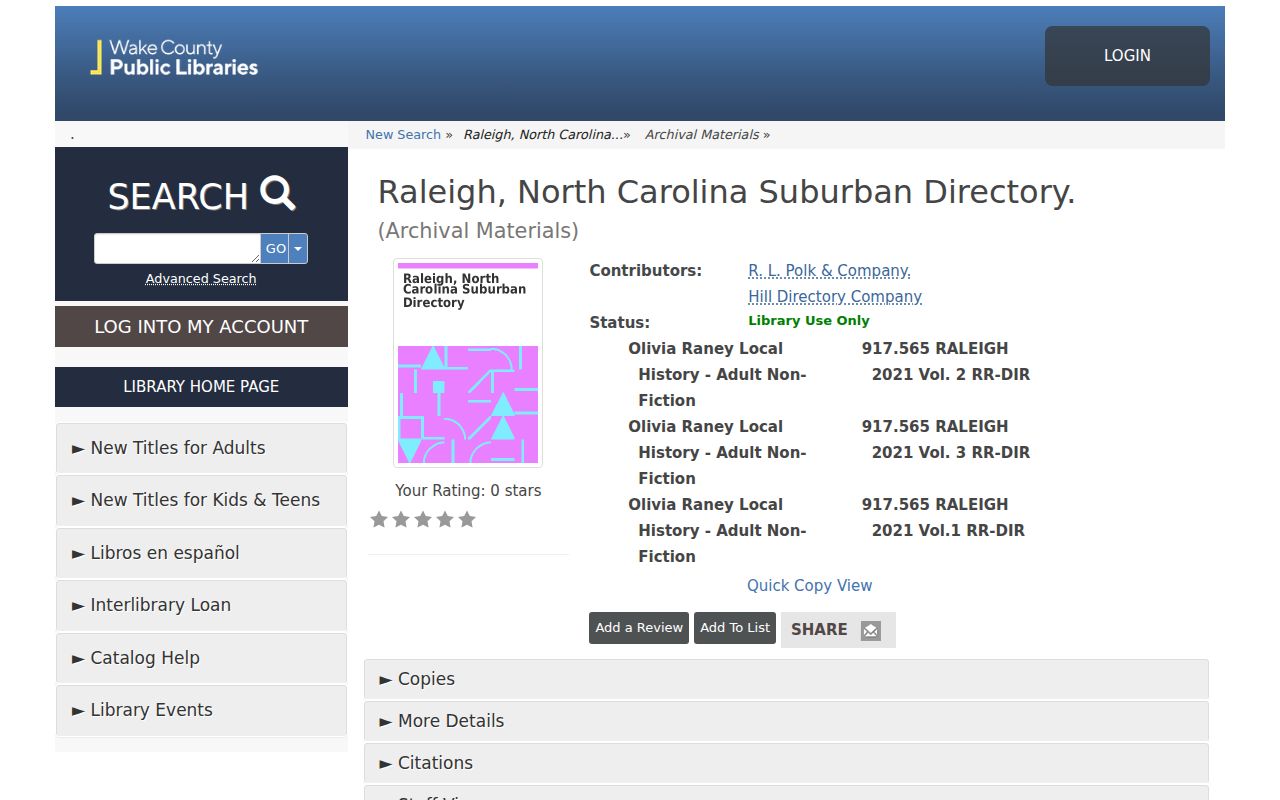
The Wake County library listing is a practical reminder to check the edition and its coverage before treating an address gap as evidence.
Wake County CRPI Records by Date
The Wake County Register of Deeds uses a split route that should be stated plainly in a Wake County research note. The CRPI transition notice directs users to the old application for recorded documents from July 1785 through April 17, 2025. The new application is the current recorded-document route. Record which application was used, the date searched, and the document identifier, because the April 2025 change affects how an image is reached.
| Grantor or grantee | Name search accepts at least three characters; use last name first where expected and choose individual, firm, or both. |
|---|---|
| Document type | Optional filter with codes such as DEED, MAP, MTG, QCD, EASMT, RELEASE, SUBN, UCC, and JUDGT. |
| Recorded dates | On-or-after and before fields use mm/dd/yyyy and can narrow a name search. |
| Book and page | Book needs four characters and page needs one; map and condominium records use their own prefixes. |
| Search type | Standard and Sounds Like routes help test a spelling variation without treating an index result as the instrument. |
Wake CRPI is a free public index and image route for ordinary searches. It is a finding aid, not the official underlying document. Search spelling variants, open the image, and keep the recorded date, book/page, parties, legal description, and prior-reference clause in the same note.
Note: A tax-card owner, deed party, or mailing field describes a record role at a date and does not by itself identify who lived at the address.
Trace Wake County Past Owners Through Deeds
A deed chain follows the parcel and the recorded parties backward. Begin with the Wake County Real Estate Search to capture the current Real Estate ID, PIN, situs address, and legal-description clues. Then use the current owner’s acquisition as the first CRPI lead. A street address can change over time, but a legal description and parcel history give the search a more stable thread.
- Open Wake County Real Estate Search and record the address, REID, PIN, displayed owner, and legal-description or lot clues. The address form asks for street number and street name, with street type omitted.
- Use the buyer’s name as the grantee, or use a known book/page, in the CRPI route appropriate to the recorded date. Limit by document type and date if the name is common.
- Read the image, not only the index line. Capture the recording date, grantor, grantee, book/page, legal description, and any prior deed reference.
- Take the seller from that deed and search that person or firm as grantee for the earlier acquisition. Repeat the sequence one recorded instrument at a time.
- When the index route or image is not enough, request the specific document or consult the Register of Deeds rather than guessing from a current address.
- Grantor and grantee
- The grantor transfers an interest named in the instrument; the grantee receives the stated interest.
- Chain of title
- A dated sequence of recorded instruments that connects one parcel interest to an earlier one.
- Legal description
- The lot, subdivision, metes-and-bounds, or other recorded parcel description that can remain useful when a street label changes.
The Register’s recorded-document request form accepts document type, book/page or grantor/grantee/date details, copy type, quantity, requester contact and mailing information. A certified copy is listed at $5 for the first page and $2 for each additional page, while a one-page certified map is $5. Mail a check or money order, not cash, to Wake County Register of Deeds, P.O. Box 1897, Raleigh, NC 27602; the form states one-business-day processing and lists 919-856-5476 for recorded-document information. The recorded-document request form is the mail-copy route, and current fees should be confirmed before payment.
Wake County Previous Residents and Map Books
Maps help test whether the historical address and the physical place line up, but they do not identify every household. In CRPI, map-book searches use BM plus a four-digit year, while condominium-map searches use CM plus a four-digit year. That small Wake County search rule can matter when a recorded plat is the bridge between an old street number and a later parcel description.
Use the parcel record, deed, plat, and map as a dated Wake County sequence: address to REID or PIN, then deed image, then legal description or plat, then the historical map. The current Raleigh/Wake iMAPS viewer can add property boundaries, addresses, deeds, permits, subdivisions, ZIPs, corporate limits, and planning jurisdictions. Its layers support a geographic cross-check, not a legal boundary ruling or an occupancy conclusion.
Wake County legacy permits are another period-specific lead. The Wake legacy permit portal covers records before July 1, 2018, while Raleigh’s current development route covers a later portal and archive. Label the old and current routes separately so a search result is not read as a complete construction record.
Wake County Previous Residents in Directories
Recorded ownership is only one part of an address story. A dated directory can place a printed name at a street number, and a street section can add nearby address context. The local volumes are covered in detail in the Wake County city directory collections; use the page image, publisher, edition year, and printed page when a directory lead is added to the deed chain.
DigitalNC can be searched by city, county, and year, with official partner scan leads for Hill’s Raleigh 1925 and 1933. Olivia Raney’s Raleigh catalog lists uneven early holdings, much fuller later coverage, and a separate Suburban record. These are historical Wake County listings, not a claim that a named person remained at the address between editions. A change in the printed name, an omitted year, or a different street number should lead to a closer look at deeds, plats, maps, and city limits.
WakeHistory provides county-history orientation alongside the local record trail.
That Wake County history resource supplies context for records research, while the dated directory or instrument remains the evidence for a particular address claim.
Wake County Address Evidence Needs Dates
Old street numbers can fail a modern search after subdivision, road work, annexation, or a street-name change. Wake County official sources did not establish a single Raleigh-wide historic renumbering year. Do not invent one. Instead, bridge a historic Wake County address with the nearest directory, plat, Sanborn sheet, annexation material, and parcel record, keeping the date with each source.
The historic-preservation record gives a useful Raleigh sequence: 1900 is identified as the first city directory with streets and houses listed, 1914 is paired with Sanborn material, 1925 is documented, and 1938 is identified as the first year owner occupancy was noted. The Library of Congress has Raleigh Sanborn material from July 1884 through December 1950. It can show building footprint, materials, and street context, but it does not name every resident.
North Carolina DNCR’s Genealogy of a House guide lays out the combination of deeds, maps, directories, and archives needed for a careful sequence.
The state house-history guidance reinforces the Wake County practice of matching street, building, parcel, and record date before drawing a conclusion.
The current Raleigh example of Church at North Hills changing to Bridge at North Hills effective December 31, 2026 shows why an effective date belongs in every address crosswalk.
Wake County Past Households in Context
Directories, census releases, newspapers, cemetery material, and probate files add the household layer to a Wake County deed trail. They should be paired by date, not blended into one undated narrative. A directory can provide an address-associated listing; a census release can record a household at its own enumeration moment; an obituary or probate record can point to a later event or relationship that deserves separate checking.
- Choose the available directory edition nearest the address period and save its title, publisher, year, page, and exact text.
- Use the street section or criss-cross portion where present to test the address, then note any spelling or numbering difference.
- Compare the directory year with the nearest available federal census release, retaining both source dates and images.
- Check a Sanborn sheet or recorded plat for the building and lot context before carrying a street number across decades.
- Use public newspaper notices, cemetery material, or probate files as trail endpoints, while keeping namesakes and incomplete runs in view.
Wake County newspaper holdings include titles with varied and incomplete runs. An obituary can confirm a public notice, but it is not proof of every past address or relationship. The 1930 municipal-auditorium fire also destroyed City Cemetery and Mount Hope burial records, so an absence from those municipal books should not be stated as proof that no burial occurred.
Note: Say “listed at” for a dated directory entry and reserve stronger conclusions for evidence that directly supports the narrower fact.
Wake County Historical Index Limits
The Wake County Enslaved Persons Search is a specialized historical resource, not a present-day identity tool. It can be searched by text and by date, book, page, grantor, grantee, or an enslaved person’s name. The inspected Wake County result displayed record ID, date, book, page, document ID, grantor, grantee, and enslaved persons listed, with 2,156 indexed items across 144 pages. Read the linked instrument and preserve its date, book, page, and document ID. Do not turn a historical listing into a current identity or ownership assertion.
The CRPI Enslaved Persons Search belongs in historical context only. When an existing public record must be requested from a Wake County public body, the North Carolina Public Records Act, N.C.G.S. Chapter 132 provides the governing access framework, but it does not require a custodian to create a new compilation.
Lawful personal use. Wake County address history is best used for family history, estate research, property curiosity, or a personal historical narrative. Do not use a past-resident lead to stalk, harass, or harm anyone.